Why Using Google Translate Makes Reading in Spanish Harder, Not Easier — And How to Fix It

Updated: Jun 1

Have you ever sat down to read in Spanish and ended up looking up one word, then another, then another? Twenty minutes later, you barely finished half a page, and you gave up because you were feeling exhausted.
Have you ever decided to finally read in Spanish before going to bed and found yourself reaching for your phone every few seconds to check a word on Google Translate?
What started as a relaxing evening activity turned into a frustrating back-and-forth between your book and your cell phone. Thirty minutes later, you were still on the first page, feeling demotivated, distracted, and too tired to continue.
Reading stopped feeling enjoyable and started feeling like homework.
Let me tell you that you are not the only one who experiences reading in Spanish as hard work.
This is a common mistake my students make again and again, and it’s not their fault. They have been told that “books build vocabulary,” so they assume they need to understand every single word to benefit from reading. As they want to build their vocabulary fast, they often choose books that are too difficult for their level, and spend hours glued to the dictionary.
So, this is the common mistake my beginner students make again and again:
They confuse reading with studying.
What they don’t realize is that constantly translating every unknown word is actually slowing them down instead of helping them improve their Spanish.
But here’s the good news: reading in Spanish does not have to feel frustrating or overwhelming. In fact, it can become one of the most enjoyable and natural ways to improve your Spanish and build your vocabulary—if you do it right.
In this post, I’ll show you how constantly translating while you read is actually affecting your progress, what happens in your brain when you interrupt your reading flow, and what to do so you can actually enjoy reading, finish books, and naturally build your vocabulary.
Let´s start with what happens when you interrupt your reading.
You Lose Your Reading Flow
Every time you stop to search for a word, your brain disconnects from the story.
Instead of following the characters, the emotions, and the plot, your attention jumps into “study mode.” Then, when you return to the page, you need to reread the sentence because you’ve lost the thread of the story.
Reading becomes slow and exhausting.
When you read a story for the first time, your brain wants to stay engaged in the story itself. It focuses on the characters, the situations, and what will happen next. When you get absorbed in a story, vocabulary and structures naturally sink in, and your Spanish improves without you realizing it.
But if you interrupt the process every few seconds, your brain never fully settles into the language, and reading feels like hard work.
If reading never feels rewarding or enjoyable, you probably won’t continue doing it. As humans, we naturally repeat activities we enjoy and avoid activities that feel frustrating.
That’s why so many learners quit reading in Spanish after one or two difficult books.
Reading a Single Page Takes Forever
If every paragraph turns into a vocabulary lesson, finishing a book becomes almost impossible.
If you spend an hour “studying” one chapter, you don’t feel any progress.
Instead of feeling proud and motivated, you feel discouraged and stuck.
What I tell my students is:
Finishing a book is more valuable than understanding every single word.
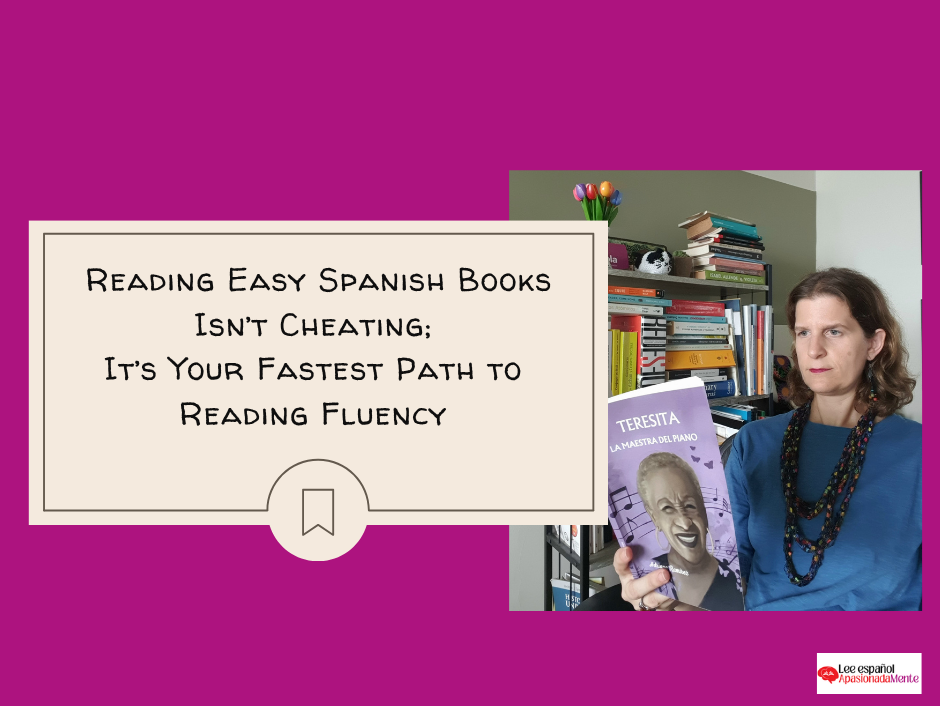
That’s why I recommend all my students who are novice readers in Spanish to begin with beginner-friendly books.
Finishing a book builds confidence, and your brain says: “I can do this.” Confidence is what keeps my learners moving forward.
One comprehensible story leads to another.
One finished book leads to another book with more vocabulary.
More vocabulary leads to fluency.
A learner who finishes five beginner-friendly books will usually improve much more than a learner who struggles through one advanced novel — and never finishes it.
Too Many Unknown Words Hinder Comprehension
Vocabulary and comprehension are deeply connected. You can only truly understand a text if you know most of the vocabulary in it.
If you are a novice reader in Spanish, the key factor for your reading comprehension is your vocabulary knowledge.
You might think that you should simply “push through” difficult books. You might feel that reading beginner-friendly books is cheating and that they are not challenging enough.
Here is the truth: If a text contains too many unfamiliar words, your brain spends all its energy on trying to understand what’s happening in the story, on deciphering who does what, and why.
Let me share an example of a real situation in my classroom.
A student encountered this sentence:
Miguel estaba muy enojado porque su ordenador se había dañado y tenía que llevarlo al taller.
Miguel was very angry because his computer had broken down and he had to take it to the repair shop.
Although the structure of this sentence is simple, some words threw my student off. He didn't know what “ordenador”, “se había dañado”, and “taller” mean. The whole sentence didn´t make sense to her.
The word “ordenador” is key to understanding here. If you don’t know that in Spain, when they say “ordenador” they mean computer, you might think that this word has something to do with “order” and “organization”, but the sentence still doesn’t make sense, especially if you don’t know what “dañarse” and “taller” mean.
On top of that, the person who wrote this sentence doesn't give you all the details because they assume that your prior knowledge will allow you to make the following inferences:
"Miguel is angry because he needs his computer for work."
"Miguel is angry because he knows that repair shops take days to fix a computer, and he can't wait that long."
"Miguel is a very busy person who doesn't have time to take his computer to the shop."
"Miguel has a deadline for a project and needs his computer."
So, without vocabulary, you not only lose the meaning of the entire text, but you also read it only at a surface level, and your brain doesn't have enough energy to make deep inferences.
Imagine if this happens in every sentence and in every paragraph.
Research shows that readers need to understand around 95–98% of the vocabulary in a text to read comfortably — and this applies not only to language learners but to native speakers as well.
When you have to think about what the words mean and how they connect:
You lose the meaning of the whole text.
You disconnect from the story.
You read less because reading is hard work.
That means difficult books with many unfamiliar words are not “helping you learn faster.” In many cases, they’re slowing you down.
Let’s see now what you can do to fix that.
Stop Mixing Reading With Studying
This is probably the most important shift you can make.
The purpose of reading a book is not to study every word.
The purpose is to enjoy the story, understand most of it, follow the characters’ adventures, and become immersed in the language.
When you become emotionally engaged in a story, something powerful happens:
Your brain stops “studying” and starts absorbing.
Vocabulary sinks in naturally.
Sentence patterns become familiar.
You build confidence, reading flow, and rhythm.
Dr. Stephen Krashen, a renowned linguist, says that good language methods are based on interesting stories that become so engaging you forget they’re in another language.
That’s the magic of comprehensible and compelling books.
Let me clarify that I’m not saying that studying vocabulary isn’t effective—I personally love to search word meaning in different dictionaries and go down the rabbit hole of synonyms and antonyms. There are many ways you can learn new words and make them stick, but interrupting your reading every 20 seconds to translate them is not the most effective way to do it.
Reading for pleasure and studying the vocabulary of a text are two different ways to approach language learning—and they work best when kept separate.
I strongly believe that both approaches are fundamental and beneficial, but if you do them at the same time, they lose their effectiveness.
As I mentioned before, vocabulary knowledge is key to reading.
Better vocabulary leads to better comprehension, and the more you comprehend, the richer your vocabulary becomes.
Also, books are like chests full of gems. In books, you find beautiful and rare worlds you won’t hear in everyday conversations.
A limited vocabulary makes comprehension superficial and shallow.
A rich vocabulary makes comprehension stronger and deeper.
Next, I will explain how you can enjoy reading in Spanish while improving your vocabulary.
Choose Books That Match Your Level
If you read the right books for your level, you’ll naturally absorb vocabulary while still understanding and enjoying the story.
Comprehensible books contain useful everyday vocabulary combined with a controlled number of important, but less common words.
The right book for a novice reader should be easy enough to understand and engaging enough to enjoy.
When the story is clear and easy to follow, your brain can often guess the meaning of a few new words naturally. But if the entire page is full of unfamiliar vocabulary, guessing becomes impossible.
That’s why beginner Spanish learners need to start with comprehensible and compelling books that offer:
Controlled vocabulary
Simple sentence structures
Gentle repetition
Engaging stories
¿How to choose the right book then? Let me share with you a práctical trick that will solve this problem once and for all.
How to Know If a Book Is Right for Your Level
You might be thinking right now: “Ok, I understand I have to read books at my level, but how can I actually know what my level is? How can I choose a book that is not overwhelming, yet will give me the boost I need?"
As I already mentioned, you need to understand 95-98% of the words in a text so you can easily understand it.
Here’s a simple trick you can use immediately to know whether a Spanish book is right for your level.
This simple rule can save you time, money, and frustration.
All my students use it, and it works beautifully.
The Five-Finger Rule🤚
Open the book to a random page (preferably somewhere in the middle).
Start reading.
Every time you find an unknown word, raise one finger.
At the end of the page, count your fingers.
The Results
0–1 unknown words → The book is easy for you.
2–3 unknown words → The book is at your level.
4–5 unknown words → Slightly challenging, but still manageable.
More than 5 unknown words → The book may feel frustrating right now.
This simple strategy can completely transform your reading experience.
Trust the rule, and your reading experience will feel enjoyable and not like a chore.
How My Program Helps You Read Without Feeling Overwhelmed
If you are wondering: “Where do I start?”, your answer is inside Lee español ApasionadaMente, my reading and conversation program for beginner Spanish learners.
Lee español ApasionadaMente was carefully designed two years ago for students who were struggling with reading in Spanish and wanted to improve their reading comprehension and fluency.
It’s a program that brings together beginner learners with the same needs and struggles.
It’s a safe space for shared reading, natural conversations, and human connection.
I’ll guide you step by step with the right books, a structure that keeps you committed, and personalized support so you can finally start enjoying reading in Spanish and see real progress.
This is a reading community where beginners:
Understand what they read and enjoy it
Feel part of a community that supports them
Gain confidence and stay committed
Build strong reading skills
Transition naturally toward authentic texts and literature
When you enjoy reading, you want to continue, and that consistency makes you progress.
If reading in Spanish has felt frustrating until now, it’s probably because you’ve been approaching reading as if it were a vocabulary test instead of an enjoyable experience.
You do not need to translate every word.
You do not need to suffer through books that are far above your level.
And you definitely do not need to turn reading into a chore.
Ready to Start Reading Spanish With More Confidence?
I’d love to help you discover which type of Spanish book is best for your current level.
Book your free 1:1 exploration session with me. In just 30 minutes, I’ll assess your reading level and help you choose the perfect book to start building real reading fluency and confidence.
And remember:
You only enjoy the books you understand.
And you only finish the books you enjoy.
About the author

¡Hola! I'm Violeta Volioti, Language Coach, book lover, and reading advocate. Learning Spanish through powerful and engaging stories is one of the most effective, fun, and satisfying ways to learn. Reading is power, and in a world filled with people glued to their phones, reading is a rebel act.
Book: María Cano, La flor de trabajo de Adriana Ramírez

Comments