Why Reading Harry Potter in Spanish Feels Impossible (When You’re a Beginner), and What to Read Instead

Updated: May 6

“I tried reading Harry Potter in Spanish… but I gave up after the first few chapters.”
My students tell me this all the time (and yes, many of them mention Harry Potter!)
Maybe you’ve done something similar.
You felt motivated to read in Spanish, and you decided your favorite book would be a good starting point. After all, you know the story, right?
You told yourself, “This is going to be fun. I’m finally going to read in Spanish.”
And here is what happened:
You read the same paragraph again and again, understanding almost nothing. You were glued to the dictionary, looking up more than ten words on a single page. You started seriously doubting yourself and thinking that your Spanish just isn’t “good enough.”
Let me tell you this: It happens all the time, and it’s frustrating and overwhelming. 😔
The problem isn’t your Spanish—it’s the book you chose.
I know exactly how that feels. Let me tell you my personal story and what I learned from it.
(I promise it has everything to do with your Spanish.) 😊
Why reading La casa de los espíritus was hard for me
The same thing happened to me—not with Harry Potter, but with another book.
When I was 14, I lived in a small coastal town—a very quiet one!—in Greece. Reading was my escape. The local bookstore felt like magic—the owner had read everything and always knew what to recommend.
One day, she handed me a book that changed my life: La casa de los espíritus by Isabel Allende—translated into Greek. I fell in love with her stories. I devoured her books. I traveled across continents without leaving my room.
Ten years later, when I decided to learn Spanish, I had one dream: To read Allende’s books in the original version. So just a few months after my first lesson, I bought La casa de los espíritus in Spanish.
I thought: “I know the story. This will be easy.”
Well… It wasn’t. 😔
I could barely understand anything because knowing the story isn't the same as understanding its vocabulary in another language.
My Spanish wasn’t “bad”; the book was too advanced for my level.
But at the time, I didn’t know that. I felt frustrated and very disappointed with myself. So I gave up. For years, I limited myself to textbook readings—safe, structured… and honestly? A little boring.
The truth is that back then (in the 90s), we didn’t have better options.
It was literature (too hard),
textbooks (too dry),
or children’s books (sometimes boring or weirdly difficult).
The good news for you is that times have changed. You don’t have to wait years for your Spanish to be good enough to read literature.
You don’t need better Spanish. You need the right book.
When you choose the right book, everything changes. Reading starts to feel lighter. You actually understand what’s happening. You feel proud, motivated, and you want to keep reading!
In this post, I’ll explain what the right book for your beginner level actually is, and how such a book can help you improve your reading skills.
Let’s jump in.
Start with a comprehensible book (not one you love)
A “good” first book in Spanish isn’t the one you love (so sorry, but that’s my honest opinion).
It’s one that’s easy for you to follow.
Let me explain what makes a comprehensible book for beginners different from a common book:
📚A comprehensible book is designed for your level. It uses familiar, everyday words that you can recognize quickly; in this way, your reading pace is good enough that allows you to understand what you read.
📚In such books, you’ll encounter words similar to English—like "terrible", "furioso", or "obediente"—so you understand them naturally without translating them.
📚The sentence structure is simple and clear, so you can easily understand who is doing what. This means you don’t feel lost in translation. 😂
📚You’ll see key phrases repeated naturally. Repetition makes words stick in your mind.
The chapters are short, you reach the end of the chapter quickly, and every time you turn a page, you feel proud of yourself and want to keep reading!
📚Finally, instead of leaving you on your own, these books support you as you read. They usually include illustrations, helpful word guides, or short summaries, making reading an enjoyable experience.
Let’s dive deeper now and see another factor that makes a book the right one.
Make sure the book is also compelling (not just easy)
Let's look closely at the options most beginners turn to first:
A loved book—often Harry Potter: Favorite novels are compelling but not comprehensible... yet! The vocabulary and sentence complexity will stop beginners on almost every page.
A Children's book: Children´s books are not always as simple as they look. They often use advanced vocabulary, idioms, or have complex structures that feel confusing to an adult beginner. And honestly? Many of them just aren't that interesting if you're over ten.
A Spanish textbook: Spanish textbooks are dry and prioritize grammar over story. They lack emotion, dialogs sound artificial, the characters have no personality, and the stories are disconnected. They are very good study materials, but don´t make you want to turn the page.
The good news is that nowadays there are plenty of comprehensible books on the market, but here is where another problem emerges:
You don´t know where to find them.
You don´t know which one is for your level.
You don´t have time to do a thorough search.
You don’t have time to experiment with different books. You just want to read a book that´s right for you.
So, let me unpack the second component that makes a book the right book.
The book must be not only comprehensible, but also compelling.
Let's see what compelling actually means for language learners.
A compelling book grabs your attention and makes you want to keep reading. It has characters you care about, a plot that pulls you in, and dramatic events that make you keep turning the pages. It can be entertaining, educational, or both. It can have cultural and historical references or inspiring real-life stories that make you reflect.
So it’s important to choose a book that is at your level, and it’s relevant to your life and your interests.
Let's be honest. Writing a story with simple language that's interesting and has deep meaning requires great skill. An easy book can be very boring if it's not crafted with intention. And if it's boring, you won't read it. And if you don’t read, you’re back to square one.
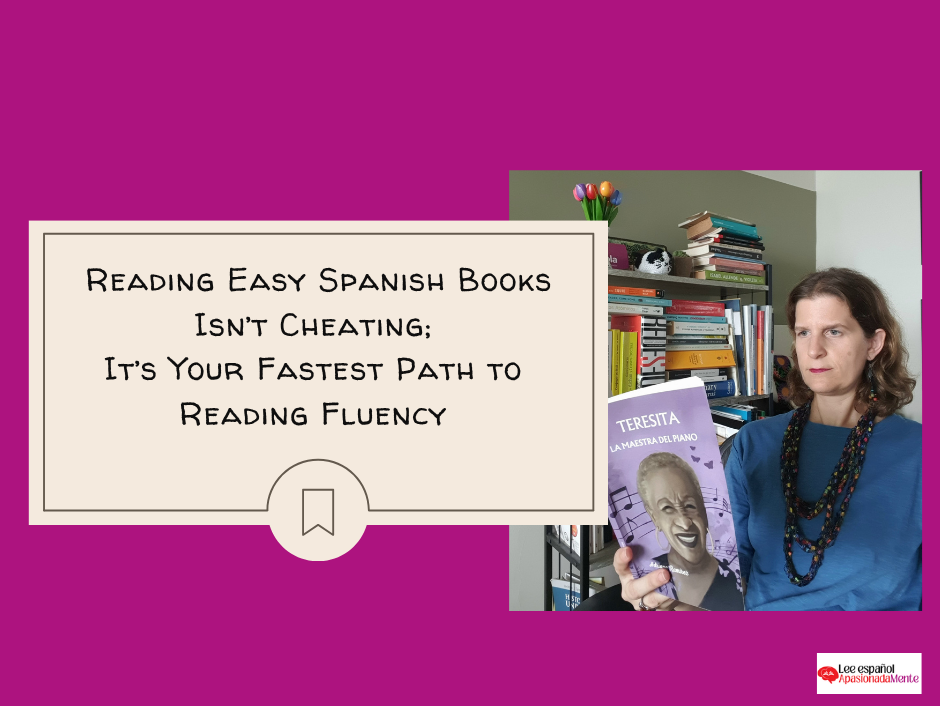
Inside my Book Club for Beginners, 📚 Lee español ApasionadaMente, I have handpicked the best comprehensible and compelling books for adult readers. I have chosen books that are not only comprehensible but also inspire, educate, and make you reflect. They are written by Latin American authors who share authentic stories of their communities that highlight their values, beliefs, and culture.
Keep in mind that comprehensible books for language learners are written taking into account the specific needs of beginners.
One interesting feature is that the opening chapters are shorter and more controlled, with simpler sentence structures and more repetition, to give you time to settle in. Think of it as a warm-up. Once you're past it, the story opens up, and the reading starts to flow much more naturally.
So, don´t judge a comprehensible book by its title or its cover. Don´t reject it because the first chapter feels simple and easy. Keep reading. Get familiar with the characters, get used to the author's writing style, and let the story pull you in. Remember that reading in a foreign language is a complex process that requires practice and patience.
But when a book is both comprehensible and compelling, magic happens🪄: it’s you, the book, and your Spanish in harmony.
Let´s see how it happens:
When you read comprehensible and compelling books, you enter a flow state, even as a beginner.
When a book is comprehensible enough that reading feels natural and compelling enough that you genuinely care about what comes next, this is what happens:
You forget you're reading in a language you're learning.
You're locked in. You're just enjoying a story.
And in this state of total absorption—the flow state—is when language sinks in almost without effort and when you’re flooded with a unique feeling of long-lasting gratification.
Instead of studying the language, you get immersed in the language, and that’s when new vocabulary and structures really become your own. When you connect with the characters, feel curious and emotionally engaged, patterns start to stick naturally.
That´s the power of stories.
And one comprehensible story leads to another.
One finished book leads to another book with more vocabulary.
More vocabulary leads to fluency.
And one day—without even realizing when and how it happened—you’ll pick up Harry Potter (or any novel you love) in Spanish…and you’ll actually enjoy reading it!
This is exactly what I see happening to my students inside my Book Club for Beginners, Lee español ApasionadaMente. They start with simple, engaging books, and step by step, they build the skills to move into more complex reading.
They build confidence with every sentence, one page at a time.
Ready to read your first comprehensive and compelling story in Spanish and actually enjoy the process?
“But where do I find comprehensible and compelling stories?” you might be wondering right now.
I have seen so many beginners struggling with books that are either too hard or too boring, so I decided to write the story they need.
My students loved it, and when they finished reading it, they asked for more and more… and more!
So, in the summer of 2025, during my family vacation on a Greek island, I felt inspired (a view of the Aegean Sea can inspire even the most novice writer!) to actually sit down and piece together the different stories and combine them into a comprehensible and compelling book.
I decided to write the kind of story I wish I had when I started learning Spanish.
And what an enjoyable process it was!
With Fernando en el Caribe y ¡sin chancletas!, you can have a first real reading experience that builds confidence.
The kind of book that makes you think: “Oh… I can actually read in Spanish.”
Why keep postponing reading in Spanish until you have a higher level and not start right now?
Download your free story Fernando Odia las Tormentas and take your first step toward confident and enjoyable reading in Spanish.
If you are a novice reader in Spanish, this story is right for you!
Here is what Fernando Odia las Tormentas includes:
A short, 2-page story with useful, real-life expressions
A Spanish-English visual dictionary
A phrase guide for extra support
Comprehension questions to help you fully understand the story
Personal reflection questions to connect it to your life
Optional activities to go deeper and track your progress
With this story, you will:
✅Build confidence and reading flow
✅Improve your vocabulary naturally (no memorizing required)
✅Strengthen your reading skills one page at a time
✅Experience Spanish in a way that feels light and enjoyable
Meet Fernando, discover why he hates storms, and learn fun facts about Mars through basic, practical sentences you can use in everyday conversations.
When you choose books that are easy to understand and interesting to read, reading becomes something you enjoy—not something you avoid.
You’ve got this—and I’ll be right there with you every step of the way.
Start with your first story today.
Sobre la autora

¡Hola! I'm Violeta Volioti, Language Coach, reading lover, and advocate. Learning Spanish through powerful and engaging stories is one of the most effective, fun, and satisfying ways to learn. Reading is power, and in a world with people glued to their phones, reading is a rebel act.


Comments